
LEARN THE SKILLS
Understanding your customers
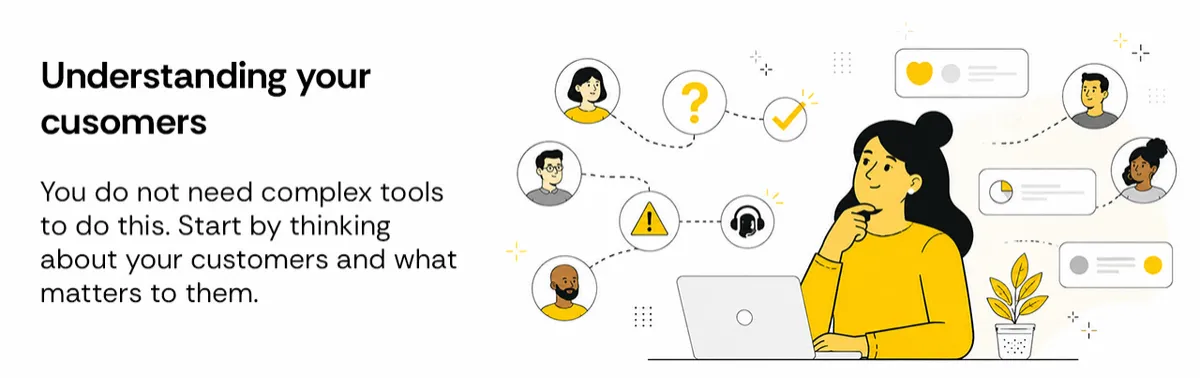
To build a useful website, you need to understand your customers. This means knowing who they are, what problem they need solved and why they would choose your business.
Why understanding your customers matters
A Google Business Profile is a business listing that appears on Google. It can help customers find key information quickly, such as:
Business name
Business category
Address or service area
Phone number
Website link
Opening hours
Photos
Reviews
Updates
It is useful for local businesses, mobile services, service-area businesses, shops, trades, health and wellness services, food businesses and many other small businesses.
Why your Google Profile is important
Your website should speak directly to the people you want to help. When you understand your customers, you can:
Explain your services clearly
Use words your customers understand
Focus on the problems they want solved
Show how your business can help
Build trust and confidence
Make it easier for customers to choose you
If your website is too general, customers may not feel it is right for them.
Identify your main customer types
Most businesses have a few main types of customers. Think about who you usually work with.
For example:
Homeowners needing regular services
Small business owners needing support
People planning an event
Customers looking for a one-off service
Customers needing urgent help
You do not need to list every possible customer. Focus on your most common ones.
Understand the problem they need solved
Customers usually visit your website because they have a problem or need.
Ask yourself:
What problem does my customer have?
What are they trying to achieve?
What is frustrating or difficult for them?
What outcome do they want?
For example:
A customer may need a cleaner before moving out
A business owner may need help managing finances
A pet owner may need a convenient grooming service
A homeowner may need help maintaining their garden
Your website should clearly show that you understand these needs.
Explain how your business helps
Once you understand the problem, explain how your business solves it.
Focus on:
What you do
Who it is for
What result the customer can expect
Keep your explanation simple and clear.
For example:
We provide reliable end of lease cleaning to help tenants leave their property in good condition. Avoid vague statements that do not explain the benefit.
Use clear and simple language
Your customers may not understand technical terms or industry language.
Use plain language that is easy to read.
Less useful:
Comprehensive residential exterior maintenance solutions
More useful:
Lawn mowing and garden clean-ups for local homes
Write as if you are speaking directly to your customer.
Show why you are the right option
Customers often compare businesses before choosing one. Help them understand why your business is a good choice.
You can do this by showing:
Your experience
Your reliability
Your approach to customer service
Your local knowledge
Your quality of work
Your availability or flexibility
Keep your claims honest and realistic.
Answer common questions
Customers often have similar questions before they contact a business.
Think about what they may want to know, such as:
What is included in the service?
How much does it cost?
What areas do you service?
How do they book?
What should they expect?
Answering these questions on your website can make customers feel more confident.
Make it easy for customers to take the next step
Once a customer understands your service, they should know what to do next.
Make your next step clear, such as:
Call your business
Send an enquiry
Book a service
Request a quote
Place contact options where they are easy to find.
Keep your customer in mind when updating your website
When you review your website, think about your customer.
Ask yourself:
Does this page clearly explain who this is for?
Does it explain the problem and solution?
Is the language easy to understand?
Does it show why this business is a good choice?
Is the next step clear?
Your website should always focus on helping the customer.
Quick checklist
Check that your website:
Clearly identifies your main customer types
Explains the problem your customer has
Shows how your business helps
Uses simple and clear language
Explains why your business is a good choice
Answers common customer questions
Makes the next step easy to follow
Suggested task
Think about one main type of customer and write a short summary.
Use this structure:
Customer type: Add who they are.
Problem they need solved: Describe the problem.
What they want to achieve: Describe the outcome.
How my business helps: Explain your service.
Why they would choose my business: List one or two reasons.
Next step for the customer: Add what they should do next.
Related topics

MTC FutureReady acknowledges the Traditional Custodians of the lands on which we live, meet and work, and pays respect to Elders past and present. We are committed to walking together in meaningful reconciliation.
Explore
Learn & build
get in touch
© 2027 MTC Digital · BusinessReady — a learning resource