
LEARN THE SKILLS
Being found on Google
Customers often search online before they contact a business. Your website has a better chance of being found when each page clearly explains what you offer, who it helps and where you provide it.
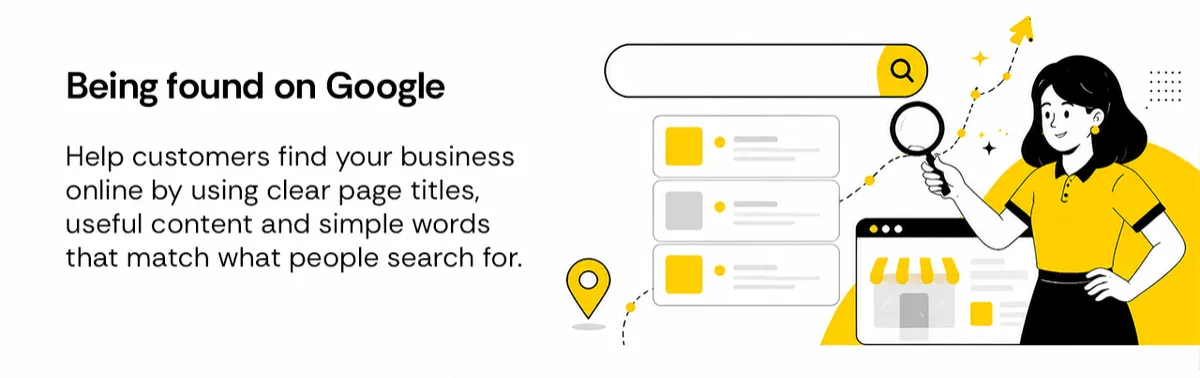
What being found on Google means
Being found on Google means your website can appear when people search for something related to your business.
For example, a customer may search:
Mobile dog wash near me
Bookkeeper for sole traders
Wedding makeup Western Sydney
Lawn mowing Campbelltown
Handmade candles Australia
Your website should make it easy for search engines and people to understand your business. You do this by using clear words, helpful page content and accurate business details.
Start with your customer’s search words
Think about what a customer would type into Google. They may not use the same words you use.
For example, you might say:
Residential outdoor maintenance
A customer might search:
Lawn mowing near me
Use simple words your customers understand.
Ask yourself:
What service do I provide?
What product do I sell?
What suburb or area do I service?
What problem does the customer want solved?
What words would a customer actually type?
Use those words naturally on your website.
Make each page clear
Each page should have one main purpose.
A services page should explain your services.
A contact page should help people contact you.
An about page should build trust.
A product page should explain the product.
Do not make every page say the same thing.
For example, if you offer cleaning services, your pages could include:
Home
House cleaning
End of lease cleaning
Office cleaning
Contact
Each service page can explain one service clearly. This helps customers find the right information.
Write a useful page title
A page title is the title that can appear in search results and browser tabs.
A good page title should be clear and specific.
Less useful:
Home
More useful:
Mobile Dog Washing in Penrith
Less useful:
Services
More useful:
Bookkeeping Services for Sole Traders
Use words that describe the page.
A simple page title formula is: Service or product plus location or customer type
Examples:
Lawn Mowing in Blacktown
Wedding Makeup in Western Sydney
Bookkeeping for Small Businesses
Handmade Soy Candles Australia
Write a short page description
Some website editors let you add a page description. This is often called a meta description. This description may appear under your page title in search results. It should briefly explain what the page is about.
Example:
Mobile dog washing for small and medium dogs across the Inner West. Book a convenient at-home wash with a friendly local service.
Keep it clear and honest. Do not stuff it with repeated words.
Less useful:
Dog wash, dog washing, best dog wash, cheap dog wash, dog wash near me, dog washing service.
More useful:
Mobile dog washing for small and medium dogs across Liverpool and nearby suburbs. Send an enquiry to check availability.
Use headings that describe the page
Headings help customers scan your page.
They also help search engines understand the page.
Use headings that match what the section is about.
Less useful:
Welcome
More useful:Mobile dog washing for small dogs
Less useful:
Our options
More useful:Weekly and once-off garden care
Good headings help people find answers faster.
Add your location or service area
If your business serves a local area, say where you work. This helps customers know if you can help them.
Add your area in natural places such as:
Home page introduction
Services page
Contact page
Footer
Frequently asked questions
Example:
We provide lawn mowing and garden clean-ups across Campbelltown, Narellan and nearby suburbs.
Do not list too many suburbs if they do not reflect where you actually work. Keep it accurate.
Create helpful content, not empty pages
A page should help the customer understand your business.
Useful content may include:
What is included
Who the service is for
What areas you service
How to book
What the customer should prepare
Common questions
Pricing guidance, if suitable
Photos of your work, if available
Avoid pages that only have a heading and one sentence. If a page does not help the customer, improve it or remove it.
Make your contact details easy to find
Search traffic is only useful if customers can contact you. Make sure your contact details are easy to find.
Include:
Phone number, if used
Email or enquiry form
Service area
Opening hours, if relevant
Social media links, if used
Business address, if customers visit you
Check that your contact page works on mobile.
Keep your website up to date
Outdated information can confuse customers and reduce trust. Review your website regularly.
Check:
Services are current
Prices are current, if listed
Opening hours are correct
Contact details are correct
Broken links are fixed
Old offers are removed
Photos still match your business
Search visibility takes time. Keeping your site useful and accurate helps over the long term.
Quick checklist
Check that your website:
Uses words your customers would search for
Has clear page titles
Has short page descriptions where available
Uses helpful headings
Explains one main topic per page
Includes your service area where relevant
Has useful content on each page
Makes contact details easy to find
Is kept up to date
Suggested task
Choose one service page and review it.
Write down:
What service is this page about? Add the service.
What location or area does it apply to? Add the location or service area.
What would a customer search for? Add three possible search phrases.
Is the page title clear? Yes or no.
Does the page explain the service properly? Yes or no.
What needs to be improved? Add your notes.
Related topics

MTC FutureReady acknowledges the Traditional Custodians of the lands on which we live, meet and work, and pays respect to Elders past and present. We are committed to walking together in meaningful reconciliation.
Explore
Learn & build
get in touch
© 2027 MTC Digital · BusinessReady — a learning resource